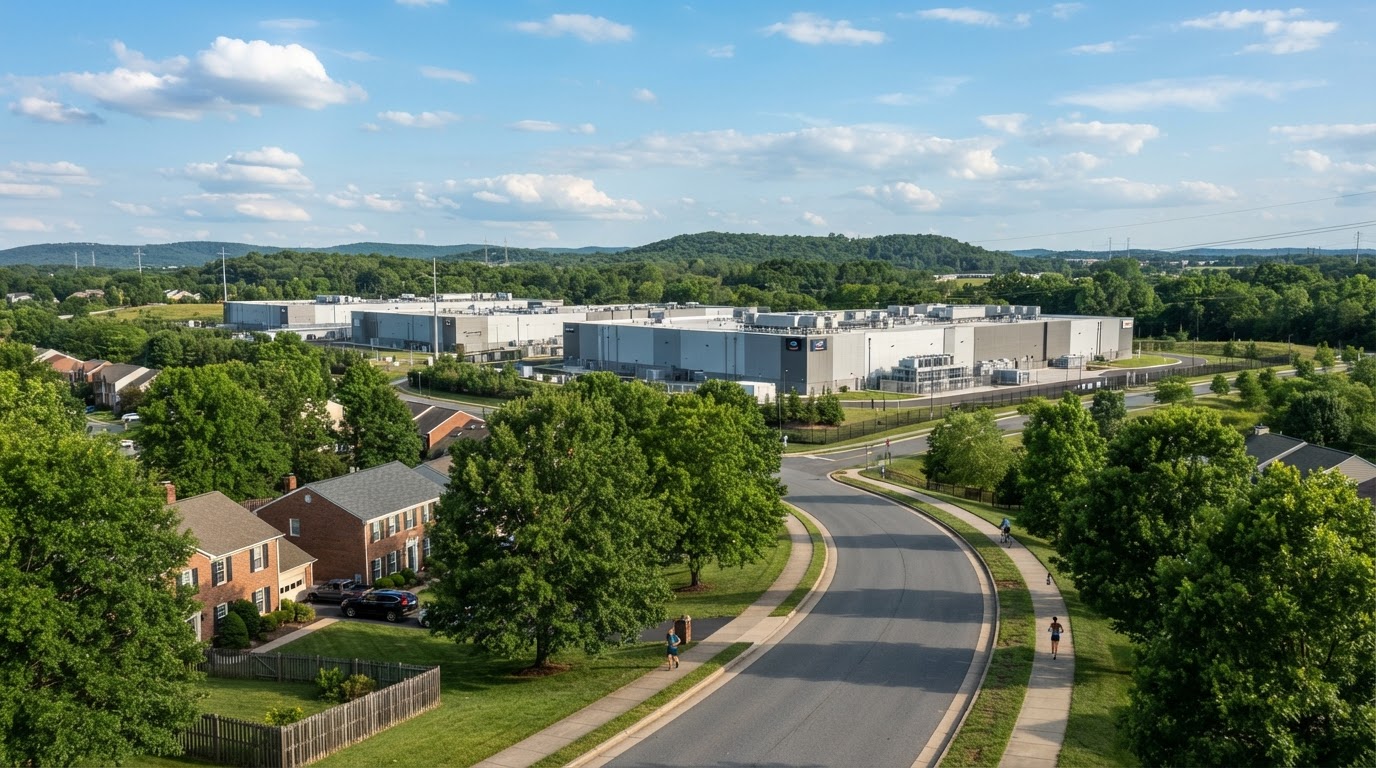
New research from Daniel Yue, assistant professor of Information Technology Management at Georgia Tech's Scheller College of Business, and co-author Yiyang Zeng, provides one of the most rigorous examinations to date of how data center openings affect local jobs, wages, business activity, and electricity prices. Their findings suggest that geography plays a decisive role in whether communities see meaningful economic gains.
The study examined data center openings across the United States, analyzing employment, wages, business establishments, household income, building permits, and electricity prices in host counties before and after facility openings.
Key Findings
On average, the researchers found that when a data center opens, the host county sees a measurable lift: employment rises by about 3.5%, wages by 5%, business establishments by nearly 5%, and household income by about 2%. Building permits also increase sharply, reflecting construction activity tied to new facilities.
However, the researchers discovered that these gains are much smaller than what might be expected from the scale of investment involved. Data centers employ relatively few permanent workers — often fewer than 100 — and many specialized services are imported from outside the host county.
Metro vs. Rural: A Critical Divide
The researchers' clearest finding is that metropolitan areas capture most of the economic benefits from data centers, while rural areas see far fewer spillover effects. The reason comes down to what economists call "agglomeration" — economic density.
Data centers rely on construction contractors, engineers, equipment suppliers, professional services, and a skilled workforce. Those connections are far easier to build in places that already have deep labor markets and established business networks. In metropolitan areas, high-wage technical employees support restaurants, retail, and local services, amplifying the impact of the initial investment. In rural areas, the broader economic ripple never fully materializes.
The research does find a small but real drop in unemployment rates in non-metro counties, and local governments may still gain tax revenue or infrastructure investments. But the overall economic spillover is significantly smaller.
The Electricity Trade-Off
Yue and Zeng's research also uncovers an important trade-off. Data centers use substantial amounts of electricity — a single large facility can consume as much power as roughly 80,000 homes. In areas where the researchers can cleanly measure price effects, electricity prices rise by about 5% after a data center enters.
"When the benefits to communities are small, even downsides like higher electricity prices that strain infrastructure will be felt by locals," Yue noted. The finding underscores the importance of ratepayer protection frameworks and fair cost-allocation mechanisms.
What This Means for Communities
The research suggests communities should ask specific questions about who pays for new infrastructure, how costs will be distributed, and what enforceable benefit structures are in place. "It's vital that communities look past flashy, headline incentive packages and focus on the details: tax abatement structures, electricity tariff arrangements, and who ultimately pays for infrastructure upgrades," the researchers concluded.
ADIC supports evidence-based decision-making by communities considering data center development. This research reinforces the importance of understanding that economic benefits vary significantly by location, project structure, and community characteristics — and that communities should evaluate proposals based on their specific circumstances rather than generic promises.